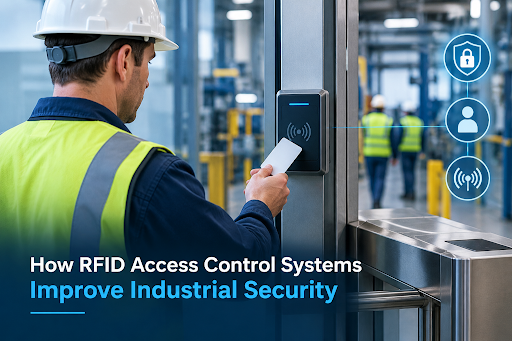
Industrial facilities face a wide range of security challenges, from unauthorized entry and equipment theft to workplace safety risks. Managing access manually can become difficult when employees, contractors, and visitors move through busy manufacturing plants, warehouses, and industrial sites.
An RFID access control system offers a practical way to improve security by identifying authorized personnel and controlling access to designated areas. By using radio-frequency identification (RFID) technology, businesses can streamline entry procedures, strengthen employee access management, and improve visibility across their facilities.
When implemented correctly, these systems support a safer, more organized working environment without adding unnecessary complexity to daily operations.
What Is an RFID Access Control System?
An RFID access control system uses radio waves to identify authorized people through RFID cards, badges, or other compatible credentials. When an employee presents a credential to a reader, the system checks the associated access permissions and determines whether entry should be granted. Depending on the configuration, the system can control doors, gates, turnstiles, and entry points leading to restricted industrial areas.
Unlike traditional keys, RFID credentials can be managed centrally, making it easier to update permissions when employees change roles or leave an organization. For example, a manufacturing company can authorize technicians to enter maintenance areas while restricting access to sensitive equipment rooms.
This approach helps security teams manage permissions consistently and reduces their reliance on physical keys and manual identification checks.
Key Benefits of RFID Access Control in Industrial Facilities
An effective industrial security system must protect people, property, and critical operations. RFID access control supports these objectives by creating a structured process for verifying identity and managing entry.
One major benefit is improved access control. Businesses can assign permissions according to job responsibilities, departments, or designated work areas. If an employee no longer requires access to a restricted location, administrators can update the relevant permissions rather than collecting and replacing physical keys.
RFID systems can also help improve accountability by recording access events when the installed system supports logging. These records can assist authorized personnel in reviewing entry activity, investigating security incidents, and identifying potential weaknesses in existing procedures.
For facilities with multiple entry points, centralized management can make access administration more consistent. However, organizations should configure appropriate permissions, protect system credentials, and regularly review access records to maintain effective security.
How Touch-Free Access Control Improves Workplace Efficiency
In busy industrial environments, long entry queues can delay shift changes and interrupt the movement of workers between departments. Touch-free access control helps simplify these processes by allowing employees to present compatible RFID credentials to a reader without inserting a card or using a traditional key. This contactless identification method can make authorized entry more convenient while helping security personnel maintain consistent access procedures.
For example, a warehouse may use RFID readers at employee entrances, loading areas, and designated production zones. Workers can move through authorized checkpoints more efficiently, while the system verifies their credentials according to configured permissions. However, the actual improvement depends on reader placement, system configuration, and the volume of people entering the facility.
RFID Personnel Identification and Industrial Safety
Industrial facilities often contain hazardous machinery, high-voltage equipment, chemical storage areas, and other locations that require strict access restrictions. RFID personnel identification helps organizations limit entry to workers who have the appropriate authorization for specific areas. This supports workplace safety by reducing the likelihood of unauthorized access to potentially dangerous environments.
When connected to suitable management software, an RFID access control system can also support personnel tracking by recording credential activity at designated checkpoints. These records may help security teams review entry events and understand who accessed particular areas at specific times.
However, access logs do not automatically provide continuous, real-time location tracking or guarantee that a person remains safe inside a facility. Organizations should combine access control with appropriate safety training, emergency procedures, and established visitor management policies.
Choosing the Right RFID Access Control Solution
Selecting suitable RFID access control solutions requires more than comparing readers and employee badges. Industrial decision-makers should assess the facility’s layout, number of access points, environmental conditions, and level of security required. Equipment installed outdoors or near manufacturing machinery may need protection against dust, moisture, temperature changes, and physical impact.
Compatibility is equally important. Businesses should confirm that the proposed system can integrate with existing doors, security software, and other relevant infrastructure. They should also consider future expansion, credential management, maintenance requirements, and the protection of sensitive access data.
For facilities evaluating specialist solutions, RFID access control system options can provide a useful starting point for understanding RFID-based access management applications. Before implementation, organizations should also assess credential security, encryption where supported, administrator permissions, and audit logging. The National Institute of Standards and Technology provides guidance on managing RFID security and privacy risks.
Conclusion
An RFID access control system can strengthen industrial security by improving employee identification, restricting access to sensitive areas, and simplifying everyday entry management. It can also support workplace safety, operational efficiency, and accountability when integrated with appropriate security procedures.
Nevertheless, the technology works best as part of a broader industrial security system rather than as a standalone solution. By evaluating facility requirements, selecting suitable credentials, and maintaining clear access policies, businesses can build a more secure and efficient working environment.