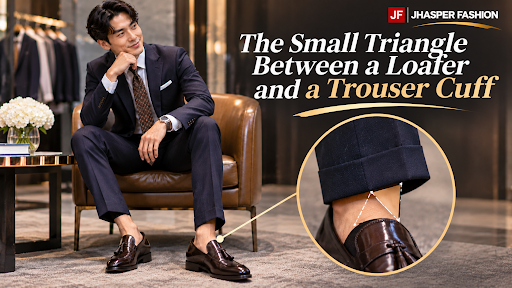
A loafer reveals a part of a trouser hem that a lace-up can hide. Look down at one foot set slightly ahead of the other. Between the front edge of the trouser and the low curve of the shoe, a little wedge of sock sometimes appears. It might be a flash of burgundy, a dark sliver, or bare ankle. Before reaching for the tailor’s chalk, decide whether you like seeing it.
The wedge has several authors. One is the vamp, the piece of leather over the top of the foot. A loafer cut high across the instep occupies more of the opening than a low-cut loafer. Another is the bottom of the trouser leg. A narrow hem can catch on that same instep, even when the cloth looks long enough to cover it. A shorter trouser with a wider opening may fall back into place more readily after a step.
Change the shoe before the hem
Make the comparison with one pair of trousers and two pairs of shoes. Wear the same socks so color doesn’t confuse the issue. In the first pair, stand naturally, take three steps, and stop. Repeat in the second pair. Look for the point where cloth first touches leather. If the hem settles cleanly with one shoe and sticks on the other, the shoe has just saved you from shortening both legs to fix a problem that only exists on Tuesdays.
For a sharper reading, put a contrasting sock on one foot and a trouser-colored sock on the other. The shape of the opening stays roughly the same while the contrast changes. A bright slice of sock can make a perfectly ordinary opening look enormous. Switching socks back may be the only alteration your eye was asking for.
Before you change anything, pull the trousers up to the place where you intend to wear them. A waistband that slips while you walk sends extra cloth down both legs. Pinning the hems with the waistband low can leave the trousers shorter than you wanted the moment you tighten your belt. Sit down, stand up, and see whether the waist finds the same spot on its own.
Mark the moving leg
If you’re ordering trousers, bring the loafers you actually wear. Trousers are available separately among the menswear at Jhasper Fashion in Bangkok, which makes the hem a decision a customer can revisit without commissioning an entire suit. Ask to see the proposed length pinned, then walk to a mirror far enough away to show both feet. A close-up from phone height exaggerates small changes at the shoe.
Have the tailor pin just one leg at first. Stand with your feet parallel and look at the pinned side beside the untouched one. You may prefer a little softness above the loafer to the sharper line you thought you wanted. Keeping one leg as a reference makes that preference easier to see.
Look once while standing and once on the turn. The right length for a man who likes a flash of sock will differ from the length for one who wants the cloth to brush the leather. Save a side-view photo with the shoes in the frame. Months later, “like this, with these loafers” will be a more faithful instruction than a remembered fraction of an inch.