New Orleans Saints vs Los Angeles Chargers Match Player Stats: Complete Game Analysis and Highlights

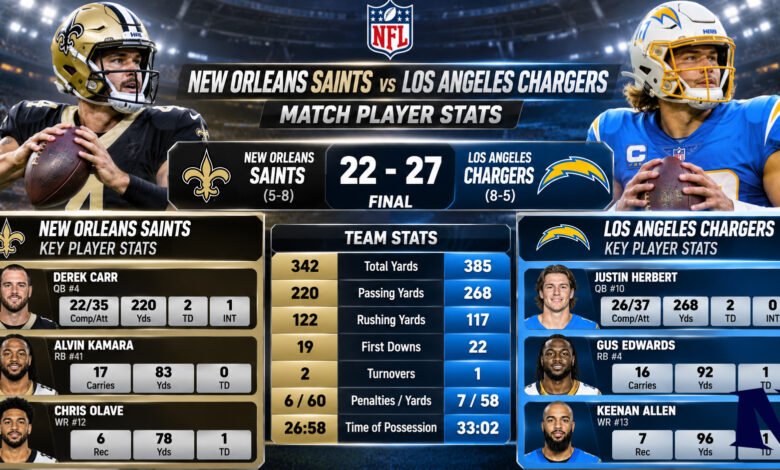
The New Orleans Saints vs Los Angeles Chargers match player stats reveal an exciting NFL matchup featuring strong quarterback performances, important defensive plays, and several game-changing moments. Both teams entered their October 27, 2024, meeting looking to improve their position in the league, but the Chargers delivered a convincing performance and secured a 26–8 victory at SoFi Stadium in Inglewood, California.
Justin Herbert led the Chargers with an efficient passing performance, while rookie quarterback Spencer Rattler started for the Saints before Jake Haener took over. The game also featured an impressive receiving performance from Ladd McConkey and a disciplined Chargers defense. This article covers the final score, player statistics, team performance, scoring summary, and the key moments that decided the contest.
Quick Facts: New Orleans Saints vs Los Angeles Chargers
| Match Detail | Information |
|---|---|
| Match | New Orleans Saints vs Los Angeles Chargers |
| League | National Football League (NFL) |
| Season | 2024 NFL Regular Season |
| Week | Week 8 |
| Match Date | October 27, 2024 |
| Venue | SoFi Stadium |
| Location | Inglewood, California, USA |
| Home Team | Los Angeles Chargers |
| Away Team | New Orleans Saints |
| Final Score | Chargers 26, Saints 8 |
| Winning Team | Los Angeles Chargers |
| Chargers Head Coach | Jim Harbaugh |
| Saints Head Coach | Dennis Allen |
| Chargers Starting Quarterback | Justin Herbert |
| Saints Starting Quarterback | Spencer Rattler |
| Leading Receiver | Ladd McConkey |
| Broadcast | FOX |
| Match Type | Regular Season |
New Orleans Saints vs Los Angeles Chargers Match Overview
The Chargers controlled most of the contest through strong defense, balanced offensive execution, and timely scoring plays. Although the Saints managed to keep the game relatively close during the first half, they struggled to create consistent offensive opportunities. Los Angeles gradually increased its advantage and prevented New Orleans from establishing a reliable rhythm.
Justin Herbert played an important role in the victory by connecting with his receivers and extending plays when necessary. Ladd McConkey emerged as the standout offensive player, scoring two receiving touchdowns. The Chargers also benefited from effective field-goal kicking and defensive pressure that kept the Saints from reaching the end zone.
New Orleans Saints vs Los Angeles Chargers Final Score
| Quarter | New Orleans Saints | Los Angeles Chargers |
|---|---|---|
| First Quarter | 2 | 0 |
| Second Quarter | 3 | 9 |
| Third Quarter | 0 | 7 |
| Fourth Quarter | 3 | 10 |
| Final | 8 | 26 |
The first quarter was unusual because New Orleans scored the game’s opening points through a safety. However, the Saints could not turn that early advantage into offensive momentum. The Chargers responded with nine points in the second quarter and entered halftime ahead 9–5.
Los Angeles added a touchdown in the third quarter and another ten points in the fourth. New Orleans managed only a field goal after halftime. The final score reflected the Chargers’ stronger offensive production and their ability to finish important drives.
New Orleans Saints vs Los Angeles Chargers Match Player Stats
The individual player statistics provide a clearer picture of how Los Angeles secured the victory. The Chargers received productive contributions from their quarterback, running backs, receivers, and defensive unit. Meanwhile, New Orleans struggled to maintain possession and generate explosive plays against a well-organized defense.
Quarterback Player Stats
| Player | Team | Completions/Attempts | Passing Yards | Passing TDs | Interceptions |
|---|---|---|---|---|---|
| Justin Herbert | Chargers | 20/32 | 279 | 2 | 0 |
| Spencer Rattler | Saints | 12/24 | 156 | 0 | 0 |
| Jake Haener | Saints | 9/17 | 122 | 0 | 0 |
Justin Herbert was the most effective quarterback in the matchup. His 279 passing yards and two touchdown passes helped the Chargers build their lead. More importantly, he avoided interceptions and consistently found opportunities against the Saints’ defense.
Spencer Rattler started for New Orleans but struggled to turn passing yardage into points. Jake Haener entered later and added 122 passing yards. Despite the combined efforts of both quarterbacks, the Saints failed to produce a passing touchdown, highlighting their problems in the red zone.
Los Angeles Chargers Rushing Stats
| Player | Carries | Rushing Yards | Rushing TDs |
|---|---|---|---|
| J.K. Dobbins | 17 | 57 | 1 |
| Justin Herbert | 4 | 49 | 0 |
J.K. Dobbins provided an important rushing contribution with 57 yards and one touchdown. Although the Saints limited his average gain on several carries, he remained valuable in short-yardage situations and helped Los Angeles maintain balance between rushing and passing plays.
Herbert also contributed 49 rushing yards, demonstrating his ability to escape pressure and gain important first downs. His mobility created additional problems for New Orleans because defenders had to account for both his passing ability and his movement outside the pocket.
Los Angeles Chargers Receiving Stats
| Player | Receptions | Receiving Yards | Touchdowns |
|---|---|---|---|
| Ladd McConkey | 6 | 111 | 2 |
| Will Dissly | 5 | 41 | 0 |
| Joshua Palmer | 2 | 72 | 0 |
Ladd McConkey delivered the strongest receiving performance of the afternoon. He finished with six receptions for 111 yards and two touchdowns, making him the most influential offensive player outside the quarterback position. His route running and ability to gain yards after the catch created significant problems for the Saints’ secondary.
Joshua Palmer also contributed an important 72 receiving yards, including a long completion that helped stretch the field. Will Dissly provided reliable shorter targets, giving Herbert another option when the defense covered deeper routes.
New Orleans Saints Offensive Player Performance
New Orleans entered the matchup with several offensive challenges and struggled to overcome them. The Saints had difficulty establishing a consistent rushing attack, which placed additional pressure on their quarterbacks. Their passing game produced some yardage, but long drives frequently ended without touchdowns.
Chris Olave remained an important receiving option, while Alvin Kamara contributed as a running back and pass catcher. However, the Chargers’ defensive structure limited the Saints’ ability to create sustained scoring opportunities. New Orleans finished with eight points and failed to score an offensive touchdown.
Key New Orleans Saints Players
| Player | Position | Performance |
|---|---|---|
| Spencer Rattler | Quarterback | 156 passing yards |
| Jake Haener | Quarterback | 122 passing yards |
| Alvin Kamara | Running Back | Contributed in rushing and receiving |
| Chris Olave | Wide Receiver | Important receiving target |
| Taysom Hill | Utility Player | Not active for this matchup |
The Saints’ offensive struggles were not caused by one player alone. Protection issues, limited rushing production, and difficulty converting drives into touchdowns all contributed to the defeat. Their quarterbacks faced pressure throughout the game, making it difficult to establish a steady passing rhythm.
The Chargers also prevented New Orleans from making a major comeback in the second half. Although the Saints moved the ball at times, their inability to finish drives left them chasing the game.
Defensive Performance and Key Players
Defense played a major role in the outcome of the New Orleans Saints vs Los Angeles Chargers matchup. Los Angeles consistently pressured the Saints’ quarterbacks and restricted the effectiveness of their running game. The defensive unit also performed well in scoring situations, preventing New Orleans from turning possession into touchdowns.
The Chargers’ pass rush disrupted offensive timing, while their secondary limited opportunities for explosive plays. New Orleans also made defensive stops, particularly during the early stages, but could not sustain that level of resistance throughout the contest.
Chargers Defensive Highlights
The Chargers demonstrated strong discipline and maintained their defensive assignments throughout the game. Their ability to prevent touchdowns was especially important because New Orleans still generated passing yardage. Los Angeles forced the Saints to settle for field goals and limited their chances of changing the momentum.
The defensive performance also supported Herbert and the offense by keeping the score manageable during quieter periods. As the game progressed, New Orleans had to rely more heavily on passing plays, allowing the Chargers to focus on quarterback pressure and pass coverage.
Important Scoring Plays and Game-Changing Moments
The opening quarter produced an unexpected start when the Saints recorded a safety to take a 2–0 lead. This gave New Orleans early encouragement, but the team could not maintain control of the game.
The Chargers responded during the second quarter through Cameron Dicker’s field goals and a rushing touchdown from J.K. Dobbins. New Orleans added a field goal before halftime, but Los Angeles held a 9–5 advantage.
In the second half, Herbert connected with McConkey for two touchdowns. These scoring plays created separation and made a Saints comeback increasingly difficult. Dicker’s additional field goals helped secure the 26–8 result.
Justin Herbert’s Impact on the Match
Justin Herbert demonstrated why he remained central to the Chargers’ offensive strategy. He completed 20 of 32 passes for 279 yards and two touchdowns without throwing an interception. His passing accuracy and decision-making allowed Los Angeles to attack different areas of the field.
Herbert also contributed 49 rushing yards, making him dangerous when passing opportunities were limited. His ability to extend plays forced defenders to react quickly and helped create openings for receivers. This combination of passing and rushing production was one of the biggest differences between the two teams.
Ladd McConkey’s Standout Performance
Ladd McConkey was one of the biggest reasons the Chargers won comfortably. The rookie wide receiver recorded 111 receiving yards and two touchdowns on six catches. His performance demonstrated his growing connection with Herbert and his ability to make important plays against NFL defenses.
McConkey’s touchdowns came at crucial stages when the Chargers needed to extend their advantage. He combined quick movement with effective route running and strong awareness of defensive coverage. His performance was particularly impressive because it came during his first NFL season.
Team Comparison and Statistical Analysis
The Chargers were more effective at converting offensive opportunities into points. Their quarterback avoided turnovers, their rushing attack contributed a touchdown, and their receivers produced important gains. Los Angeles also received valuable support from its special teams.
New Orleans struggled in several important areas. The Saints could move the ball through the air, but their offensive possessions rarely produced touchdowns. The absence of a consistent ground game made the offense more predictable, while the Chargers’ defensive pressure created additional difficulties.
The biggest statistical difference was scoring efficiency. Los Angeles finished with three offensive touchdowns, while New Orleans failed to reach the end zone. This difference explains why the final margin was much larger than some of the passing statistics might suggest.
New Orleans Saints vs Los Angeles Chargers Head-to-Head History
The Saints and Chargers have met across different NFL eras, including games when the Chargers were based in San Diego. Because the teams belong to different conferences, they do not face each other every regular season.
New Orleans had enjoyed success in several previous meetings, including a 30–27 overtime victory in October 2020. That game featured Drew Brees and Justin Herbert and was much closer than the 2024 contest.
The October 2024 result gave the Chargers an important victory in the rivalry. It also demonstrated how much both teams had changed since their earlier meetings, particularly at quarterback and head coach.
Coaching Strategies and Tactical Decisions
Jim Harbaugh’s Chargers emphasized disciplined football, physical play, and offensive balance. The coaching staff allowed Herbert to attack through the air while continuing to use the running game. This approach helped Los Angeles control the contest without taking unnecessary risks.
Dennis Allen’s Saints faced a difficult challenge because of offensive injuries and inconsistent execution. The decision to use Jake Haener after Spencer Rattler reflected the team’s search for better offensive production. However, changing quarterbacks did not solve the team’s scoring problems against the Chargers’ defense.
What the Result Meant for Both Teams
The victory improved the Chargers’ record to 4–3 during the 2024 season. It provided another positive result under Jim Harbaugh and strengthened the team’s position as it continued competing for a playoff opportunity.
For New Orleans, the defeat extended a difficult period. The Saints fell to 2–6 after suffering their sixth consecutive loss. Injuries, offensive inconsistency, and defensive difficulties had created significant challenges following their strong start to the season.
The game also highlighted the contrasting directions of the two teams at that stage. Los Angeles appeared increasingly comfortable with its system, while New Orleans needed to find answers to several ongoing problems.
Interesting Facts About the Match
One unusual detail was the Saints scoring the opening points through a safety, despite ultimately losing by 18 points. Their defense and special teams provided early encouragement, but the offense could not capitalize on the opportunity.
Another important fact was that McConkey recorded his first NFL game with more than 100 receiving yards and two touchdowns. Herbert also delivered an efficient performance without an interception.
The game was played at SoFi Stadium, the shared home venue of the Chargers and Los Angeles Rams. It also marked another meeting between teams with a history of competitive interconference games.
Conclusion
The New Orleans Saints vs Los Angeles Chargers match player stats show how efficient quarterback play, strong receiving performances, and disciplined defense can decide an NFL contest. Los Angeles earned a convincing 26–8 victory behind Justin Herbert’s 279 passing yards, Ladd McConkey’s 111 receiving yards and two touchdowns, and J.K. Dobbins’ rushing score.
The Saints showed some resistance early but struggled to convert offensive possessions into points. Their quarterback changes and passing production were not enough to overcome the Chargers’ defense. Overall, the matchup demonstrated Los Angeles’ ability to control important moments and finish drives more effectively.
Frequently Asked Questions
1. Who won the New Orleans Saints vs Los Angeles Chargers match?
The Los Angeles Chargers defeated the New Orleans Saints 26–8 on October 27, 2024, at SoFi Stadium in Inglewood, California. The Chargers scored three offensive touchdowns and controlled the second half.
2. What were Justin Herbert’s player stats against the Saints?
Justin Herbert completed 20 of 32 passes for 279 yards, two passing touchdowns, and zero interceptions. He also contributed 49 rushing yards, helping Los Angeles secure the victory.
3. Who scored the most touchdowns in the Saints vs Chargers game?
Ladd McConkey scored two receiving touchdowns for the Chargers. J.K. Dobbins added one rushing touchdown. The Saints did not score an offensive touchdown.
4. How many passing yards did the Saints quarterbacks record?
Spencer Rattler threw for 156 yards, while Jake Haener recorded 122 passing yards. Together, they produced 278 passing yards, but neither quarterback threw a touchdown pass.
5. Where was the New Orleans Saints vs Los Angeles Chargers game played?
The game took place at SoFi Stadium in Inglewood, California, on October 27, 2024. The Chargers hosted the Saints in Week 8 of the 2024 NFL regular season.
See more amazing Information visit Novira Magazine