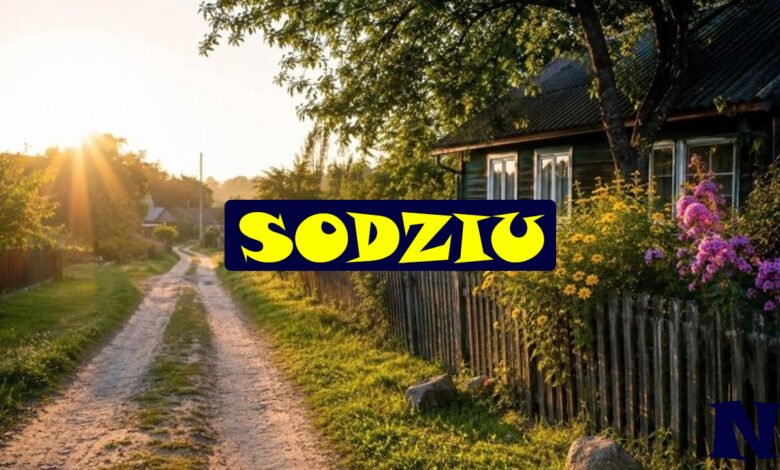
Sodziu is an unusual keyword because it does not identify a well-documented person, company, or single modern concept. The strongest linguistic evidence connects it with Lithuanian words, particularly sodžius, a term for a village or rural settlement. Another Lithuanian word, žodžiu, is sometimes confused with Sodziu online, but it has a different meaning and grammatical origin.
Understanding this difference is important because online articles sometimes combine the two terms. In an accurate explanation, sodžius belongs to the vocabulary of villages and rural settlement, while žodžiu comes from žodis, meaning “word,” and can refer to verbal or oral expression. This guide explains Sodziu using information that can be supported by public linguistic and historical sources.
Sodziu is therefore better understood as a language and cultural topic rather than a biography. The Lithuanian noun sodžius is documented with the meaning “village,” while historical reference material describes the sodžius as a form of rural settlement that existed in medieval and early modern Lithuania.
What Does Sodziu Mean?
The most reliable interpretation of Sodziu in a rural or cultural context is connected with the Lithuanian word sodžius. English-language dictionary material translates sodžius as “village” and also records related senses such as a farmstead or estate. The ordinary idea behind the term is therefore a small rural community or settlement rather than a mysterious modern concept.
Lithuanian sources provide more historical detail. Visuotinė lietuvių enciklopedija describes sodžius as a type of Lithuanian rural settlement believed to have existed between roughly the 12th and 16th centuries. Over time, the word became a synonym for kaimas, another Lithuanian term for village. This historical background gives the word a clear connection with Lithuania’s countryside and settlement history.
The Origin of Sodziu
Sodziu as typed on English-language websites lacks the Lithuanian letter ž, so readers should be careful when deciding which Lithuanian word is intended. When the discussion concerns villages, settlements, farms, or the countryside, sodžius is the relevant established word. Lithuanian grammar sources identify sodžius as a masculine noun meaning “village.”
The word also appears in research concerning Lithuanian place names. Linguistic research from the Institute of the Lithuanian Language connects sodžius with the meaning of a peasant settlement or village. This supports the historical interpretation rather than some of the unrelated meanings that have appeared on newer websites.
Sodziu and the History of Lithuanian Village Life
The historical sodžius was more specific than the broad modern idea of “the countryside.” According to the Lithuanian encyclopedia, it was a type of settlement associated with farming communities. These settlements developed as families became distributed across agricultural territory, and some settlements grew as more buildings and homesteads appeared.
The layout was not necessarily like that of a carefully planned modern village. Historical sodžiai are described as irregular settlements in which homesteads could be scattered. They generally lacked defensive fences, while early homesteads often consisted of only one building and did not have the type of organized courtyard seen in later rural settlements. These details make sodžius useful for understanding an earlier stage in Lithuania’s settlement history.
How Sodziu Changed Over Time
Lithuanian rural settlements did not remain unchanged. A major transformation took place during the 16th century. In Aukštaitija, many sodžiai disappeared as a distinct settlement type during the Valak reform in the second half of that century. Many were reorganized into more regular street villages.
The remaining settlements also developed. Homesteads gained additional buildings, fences and courtyards, changing their physical appearance and organization. Eventually, the terminology changed as well. The encyclopedia explains that these settlements increasingly came to be called kaimas, while sodžius became a synonym for village rather than continuing to identify only the earlier settlement form.
Sodziu and Lithuanian Rural Culture
Because sodžius means village and has a documented history as a rural settlement type, the term naturally appears in discussions of Lithuanian countryside heritage. However, it is important not to turn that association into unsupported claims. Sodziu is not verified as the name of one universal Lithuanian lifestyle, philosophy, artistic movement, or religious tradition.
Its cultural importance instead comes from what villages represent historically. Rural settlements were places where agricultural families lived and worked, and their changing structure reflects wider developments in land use and community organization. In this sense, studying sodžius provides a window into Lithuania’s rural past without requiring exaggerated symbolic meanings.
Is Sodziu the Same as Žodžiu?
No. This is one of the most important distinctions when researching Sodziu. Sodžius and žodžiu are separate Lithuanian forms. Sodžius is a noun meaning village, while žodžiu is grammatically related to žodis, the Lithuanian noun meaning “word.”
The form žodžiu is the instrumental singular of žodis. Dictionary material also records žodžiu as an adjective or adverb associated with oral or verbal communication. Expressions involving the word can correspond to ideas such as speaking orally or summarizing something “in a word.” Therefore, claims that Sodziu simultaneously means both “village” and “in short” can blur two genuinely different Lithuanian words.
Why Sodziu Has Confusing Meanings Online
The confusion becomes understandable when Lithuanian diacritics disappear in informal typing. The letter ž carries important information, and removing special characters can make unfamiliar words harder for international readers to identify correctly. Search engines and websites may then group similar-looking spellings together even though their meanings differ.
This has resulted in articles presenting Sodziu as a term with several supposedly connected meanings. Reliable reference material gives a cleaner picture. Sodžius belongs to village terminology, whereas žodžiu is associated with žodis, or “word.” Anyone researching Sodziu should therefore examine the context instead of assuming every online definition describes the same Lithuanian expression.
Sodziu as a Village or Rural Settlement
When Sodziu appears in material about rural Lithuania, interpreting it through sodžius makes the most sense. Lithuanian and English-language dictionary references identify sodžius with a village, and Lithuanian historical material provides a detailed account of the settlement form behind the word.
The term should not automatically be treated as the proper name of one particular Lithuanian village. Sodžius functions as a common noun, and the word has also appeared in names of organizations and businesses. A reference to “Sodziu” therefore needs context before it can be identified as a specific place, organization, or name. The underlying linguistic meaning alone does not prove that a particular geographic destination is intended.
The Structure of Historical Sodžiai
Historical evidence suggests that a sodžius was initially an irregular settlement rather than a neatly planned group of houses. Buildings and homesteads were scattered, and the settlement generally lacked the protective fencing found in some other settlement arrangements. Early individual homesteads could also be relatively simple.
This structure reflected the development of farming communities and agricultural land use. As settlements grew, additional buildings appeared and the organization of homesteads became more complex. The transformation provides historians with evidence of how Lithuanian rural communities changed before and during major land reforms. Sodziu therefore has significance not because it describes one famous location, but because sodžius represents a recognizable historical settlement category.
Sodziu, Kaimas, and Sodyba
Several Lithuanian words associated with rural places can be confusing for English speakers. Kaimas is a standard word for a village, while sodžius is also documented with the meaning “village.” Historical evidence explains why these terms overlap: after the earlier sodžius settlement type changed, sodžius eventually became a synonym for kaimas.
Sodyba is another term readers may encounter when researching Lithuanian countryside life, but these words should not simply be treated as interchangeable in every sentence. Their exact meaning depends on linguistic and historical context. For SEO content especially, keeping these distinctions clear is more useful than assigning Sodziu every possible countryside-related meaning.
Does Sodziu Have a Biography?
Sodziu does not have a biography in the usual sense because verified sources do not establish the keyword itself as a public figure. There is consequently no reliable birth date, age, birthplace, education, career history, relationship status, height, or family information that belongs to “Sodziu” as a person.
For that reason, personal details should not be created simply to complete a biography template. Where search results refer to Sodziu as a linguistic or historical topic, the appropriate “biography” is the development of the word and the rural settlement concept it describes. Personal information is not applicable.
Career and Profession
There is no verified career or profession associated with Sodziu as a single person. The established Lithuanian word sodžius is a noun, not the documented identity of a celebrity whose career can be traced through reliable public records.
The closest equivalent to a career section is the historical development of the term itself. Sodžius described a form of settlement, experienced changes in meaning as Lithuanian rural communities developed, and eventually became synonymous with village terminology. That linguistic history is documented, whereas assigning occupations, achievements, employers, or professional milestones to Sodziu would be unsupported.
Personal Life and Family
No verified personal life or family information exists for Sodziu as a linguistic term. Details such as parents, siblings, spouse, partner, or children are therefore not applicable. Any website presenting such information would need to be referring to a separately identifiable person rather than the Lithuanian word discussed here.
Family nevertheless mattered to the historical settlement structure associated with sodžius. The Lithuanian encyclopedia explains that families living within earlier communities became distributed across agricultural territories, with some settlements eventually developing into sodžiai. This is historical information about settlement formation, not a personal family biography attached to the keyword.
Physical Appearance and Height
Sodziu has no physical appearance or height because it is not established as a person in the linguistic context covered by reliable sources. Height, weight, eye color, hair color, and other physical details are therefore not applicable.
Historical sodžiai did, however, have physical characteristics. Their homesteads could be scattered rather than arranged in an orderly street pattern. Earlier settlements often lacked protective fences, and individual homesteads were initially simple. As rural organization changed, more buildings, courtyards, and fences appeared. These physical changes are documented characteristics of the settlements themselves.
Sodziu Net Worth
There is no verified net worth for Sodziu. Net worth applies to individuals, businesses, and other entities whose assets and liabilities can meaningfully be evaluated. A Lithuanian common noun or historical settlement category does not have personal wealth.
Readers should therefore be cautious if they encounter an unexplained Sodziu net-worth figure online. Unless the name clearly refers to a specific registered company or identifiable public figure, attaching a monetary value to it would be misleading. For the linguistic topic covered here, net worth is not relevant and no reliable figure can be provided.
Sodziu on Social Media
There is no verified official social-media account representing Sodziu as the Lithuanian historical and linguistic term described in this article. Individual users, businesses, pages, or organizations may use similar names, but a matching username alone does not prove that an account represents the concept itself.
Anyone searching for Sodziu on Instagram, Facebook, TikTok, YouTube, or other platforms should therefore check the identity behind the account. Without reliable verification, it would be inaccurate to list a particular profile as the “official Sodziu” social-media presence. For this topic, verified official social media is not applicable.
Sodziu in Modern Life
The historical settlement type described as sodžius changed substantially centuries ago, yet the word remains useful for understanding Lithuanian vocabulary and history. The encyclopedia notes that sodžius eventually became a synonym for kaimas, demonstrating how words can survive even when the precise social or physical structures they once described evolve.
Today, someone encountering Sodziu online should first identify the intended context. A discussion of villages probably points toward sodžius. A conversation about “in a word,” verbal communication, or summarizing speech may instead concern žodžiu. Keeping that distinction in mind prevents many of the misconceptions currently repeated across general-interest websites.
Interesting Facts About Sodziu
One interesting fact is that sodžius has a documented connection to Lithuania’s medieval and early modern settlement history. The Lithuanian encyclopedia places the historical settlement type approximately between the 12th and 16th centuries and describes its transformation during later land reforms.
Another important fact is linguistic: Sodziu should not automatically be equated with žodžiu. The latter is connected to žodis, meaning “word,” and has grammatical and adverbial functions related to words and oral expression. This small spelling distinction can completely change the meaning, making accurate Lithuanian spelling especially important when researching the keyword.
Why Accurate Information About Sodziu Matters
Sodziu is a useful example of how online content can make an unfamiliar foreign term appear more mysterious than the evidence supports. Repeating claims from one blog to another can gradually create supposed definitions that are difficult to trace back to dictionaries, encyclopedias, or linguistic research.
Using established sources produces a simpler answer. Sodžius is documented as a Lithuanian word for a village and as a historical rural settlement type. Žodžiu is a separate form connected with žodis, or “word.” Treating these meanings separately respects the Lithuanian language and gives readers a clearer explanation of what they may actually be searching for.
Conclusion
Sodziu is best approached as an ambiguous online spelling connected with Lithuanian vocabulary. In rural and historical contexts, the strongest match is sodžius, meaning a village and referring historically to a type of Lithuanian rural settlement. Such settlements existed for centuries and changed considerably during the 16th century as Lithuanian land organization developed.
It should not be confused with žodžiu, a separate Lithuanian form derived from žodis, meaning “word.” There is also no verified basis for treating Sodziu itself as a celebrity with an age, career, family, height, net worth, or official social-media profile. Understanding these distinctions provides a more accurate picture of the keyword without relying on unsupported online claims.
FAQs About Sodziu
1. What does Sodziu mean?
Sodziu is commonly encountered online without Lithuanian diacritics. When used in connection with villages or rural Lithuania, it is most accurately associated with sodžius, a Lithuanian noun meaning “village.” Historical Lithuanian sources also use sodžius for a particular form of rural settlement that developed centuries ago.
2. Is Sodziu a Lithuanian word?
The established Lithuanian form relevant to village terminology is sodžius. Writing “Sodziu” removes the special Lithuanian character and can create ambiguity. Lithuanian reference sources document sodžius as a village term, while linguistic sources show that žodžiu is a different word form. Context is therefore essential when interpreting the simplified spelling Sodziu.
3. Does Sodziu mean “in short” or “basically”?
That meaning is more accurately associated with expressions involving žodžiu, not sodžius. Žodžiu is the instrumental singular form of žodis, meaning “word,” and appears in expressions connected with verbal communication and summarizing speech. Sodžius, by contrast, means a village or rural settlement. The two should not be merged into one supposed dual-meaning word.
4. Is Sodziu a person or a place?
The reliable linguistic evidence discussed here does not identify Sodziu as one specific public figure. Sodžius is a common Lithuanian noun connected with villages and historical rural settlements. The word or similar forms can appear in names, so a particular use may identify an organization or place, but that requires separate evidence rather than assuming the keyword always names one entity.
5. Why is Sodziu important in Lithuanian history?
Sodžius is relevant because it describes an older form of Lithuanian rural settlement. Historical sources connect these communities with agricultural development and explain that many were reorganized during the 16th-century Valak reform. The term later became synonymous with village terminology, preserving a linguistic connection to an earlier stage of Lithuania’s rural settlement history.
See more amazing Information visit Novira Magazine